
What Is MCP (Model Context Protocol) and Why Every AI Agent Needs It
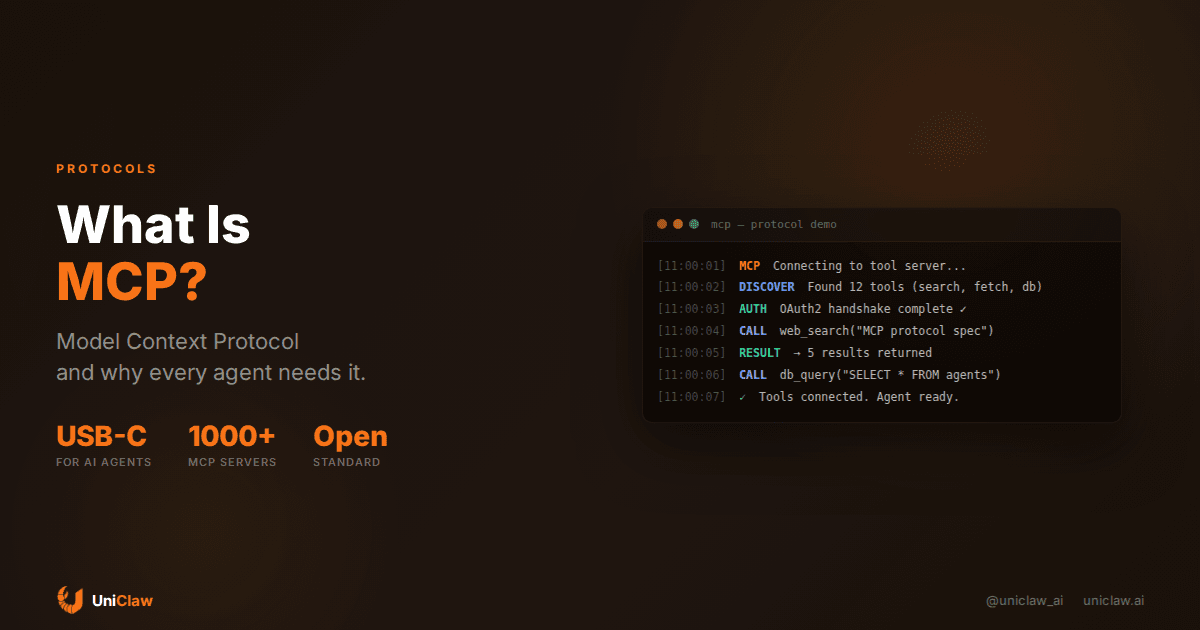
If you've been paying attention to AI agents in 2026, you've probably seen "MCP" everywhere. Anthropic introduced the Model Context Protocol in late 2024, and in about 15 months it went from an obscure spec to the thing everyone builds on. MCP gateways are now their own product category. Security researchers write papers about MCP attack surfaces. Enterprises are hiring "MCP architects," which is a job title that didn't exist a year ago.
So what is it? And is the hype justified?
I think mostly yes. But not for the reasons most people are talking about.
The actual problem MCP solves
Before MCP, connecting an AI agent to external tools was a mess. Every provider had their own API format, their own auth flow, their own way of describing what a tool could do. If you wanted your agent to search the web, read your calendar, and send a Slack message, you were writing three separate integration layers. Switch from one AI model to another and you might need to rewrite all of them.
MCP fixes this by defining a standard way for AI models to discover and use tools. The analogy that keeps working for me: USB for AI agents. Before USB, every peripheral had its own connector. After USB, you could plug anything into anything. MCP does the same thing for agent-tool connections.
An MCP server exposes tools and resources. An MCP client (your agent) connects to those servers and discovers what's available. The protocol handles capability negotiation, authentication, and message formatting. Your agent says "what can you do?" and the server replies with a list of tools, their descriptions, and their parameters.
Not complicated. The power is in the standardization, not the complexity.
Why it's happening now
A few things converged.
Every major AI lab adopted MCP or something compatible with it. OpenAI, Google, Anthropic, and the open-source community all landed on MCP as the standard. For tool developers, this means building one integration instead of five.
The MCP server ecosystem blew up. There are MCP servers for GitHub, Jira, Postgres, home automation, web search, you name it. The npm registry alone has over 4,000 MCP server packages. More servers make agents more useful, which brings more users, which brings more server developers. Classic flywheel.
And enterprises started worrying about governance. When your AI agent can connect to any MCP server and start calling tools, someone needs to decide which tools it's allowed to touch. This created a market for MCP gateways, products that sit between agents and servers to enforce policies, log actions, and manage auth.
What this looks like when you're actually using it
Say you're running an AI agent on OpenClaw. Without MCP, you'd build custom integrations for every tool. With MCP, your agent connects to MCP servers that expose what you need.
Want your agent to manage GitHub repos? Point it at a GitHub MCP server. Need database queries? There's a Postgres MCP server. Web search? Same pattern.
The setup: your agent has an MCP client built in. You configure which MCP servers it can talk to. When the agent needs to do something, it checks its available tools, picks the right one, and calls it through the protocol. The agent doesn't need to know implementation details. It knows the interface.
OpenClaw's "skills" system maps naturally here. Each skill is a tool your agent can use, and MCP standardizes how those tools are discovered and invoked. The result is that adding new capabilities to your agent goes from "write a custom integration" to "connect an MCP server."
The security problem I keep thinking about
Here's where I get a little nervous.
MCP makes it easy to give an agent access to powerful tools. That's the point. But "easy to give access" and "safe to give access" aren't the same thing.
A Reddit thread from earlier this month put it bluntly: MCP became the default way to connect AI models to external tools faster than security could keep up. We have sandboxing, permission systems, audit logging. But most deployments I've seen use maybe one of the three.
The Moltbook incident was the wake-up call. Wiz found 1.5 million API keys exposed through a misconfigured agent platform. Those keys existed because agents had been given tool access without proper scoping. MCP didn't cause this, but MCP makes handing out tool access frictionless, which makes scoping mistakes more expensive.
What we need, and what the community is actively working on, is better default security. Manifest-based permissions so agents can only call specific tools. Sandboxing so a compromised MCP server can't escalate privileges. Observability that doesn't just log what happened but answers why it was allowed to happen.
If you're deploying agents with MCP access today, start with minimal permissions and expand from there. Don't give your agent access to 20 MCP servers because you can. Give it access to the ones it actually needs. This sounds obvious, but the "just connect everything" approach is shockingly common.
MCP vs. calling APIs directly
Fair question: why not skip MCP and have your agent call APIs directly?
You can. Agents did this before MCP existed. But there are real trade-offs.
Direct API calls require the agent to know the specifics of each API: auth headers, endpoint URLs, request formats, error handling. MCP abstracts this. The agent sees "here's a tool called search_web that takes a query parameter." The MCP server handles the API-specific work behind the scenes.
More importantly, MCP gives you a single control point. Want to audit every tool call? Monitor the MCP protocol. Want to swap your search provider? Change the MCP server, don't touch the agent. Need rate limiting? Put it in the MCP gateway.
Direct API calls scatter this control across every integration. For one agent with two tools, that's fine. For an organization running 50 agents with access to 200 tools, it's a governance nightmare.
What I'm watching next
MCP Apps are starting to show up, where MCP servers don't just expose tools but render UI inside the agent's chat. Instead of "agent calls a tool and returns text," it's "agent shows you an interactive widget." Still early, but interesting for agent UX.
There's also the enterprise governance angle. Gartner is talking about "agentic constitutions," formal policies for what agents can and can't do. MCP gateways are becoming the enforcement layer. If your company is deploying AI agents, your IT team will probably be writing MCP policies before the year is out.
And multi-agent collaboration. When you have agents that need to work together, MCP provides a common language. Agent A can expose its capabilities as an MCP server that Agent B connects to. Mostly theoretical right now, but the architecture supports it.
So should you care?
If you're building or deploying AI agents, yes. MCP is becoming the standard. Fighting standards is a losing game, even when the standard isn't perfect.
If you're evaluating agent platforms, ask about MCP support. A platform with MCP support grows with the ecosystem. One without it needs custom integrations for everything, and guess who maintains those.
MCP isn't the most exciting technology on its own. It's plumbing. But it's the plumbing that lets everything else work together. In a world where AI agents are going from demos to daily drivers, that plumbing matters more than most people realize.
Want to try connecting MCP tools to your own AI agent? OpenClaw makes it simple: deploy an agent, configure your MCP servers, and let the agent handle the rest. Get started at uniclaw.ai.
Follow us on X: @uniclaw_ai
Ready to deploy your own AI agent?
Get Started with UniClaw