
AI Agents for Small Business: 7 Ways They Actually Help (Not Hype)
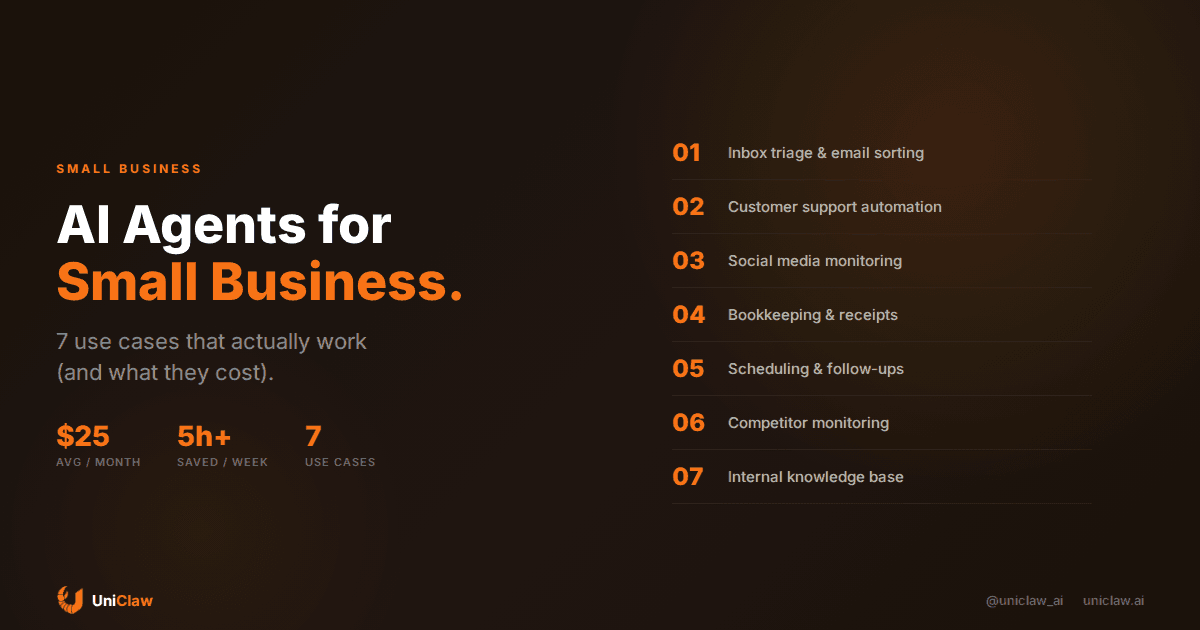
Most of what you read about AI agents is written by people selling them. Here's what actually works, what it costs, and where it still falls short.
The pitch vs. the reality
Every SaaS company on earth is bolting "AI agent" onto their product page right now. Some of it is real. Most of it is a chatbot with a new name.
An actual AI agent is software that does things on its own. Not "suggests things." Not "drafts responses you still have to send." It reads your email, decides what to do, and does it. It monitors your systems, notices problems, and fixes them while you're asleep.
That matters for a small business, where one person often does the work of five. But you need to know which problems agents solve well today and which ones they mostly just talk about solving.
1. Inbox triage: the single best starting point
This is probably the best use case for a small business AI agent right now. Not AI-powered email marketing. Just: sorting your inbox.
A typical small business owner gets 80-150 emails a day. Most of them are noise. Newsletters you subscribed to three years ago, automated notifications, CC'd threads nobody reads. The stuff that matters (client questions, invoices, urgent requests) gets buried.
An AI agent can read incoming email, categorize it, auto-archive the junk, draft replies to routine questions, and surface only what needs you. A studio owner in Portland cut her morning email time from 45 minutes to about 10.
You can set this up with OpenClaw connected to your email via IMAP. The agent runs on a schedule, checks for new messages, and handles them based on rules you write in plain English. "Archive anything that looks like a newsletter" works. You don't need regex.
What it costs: About $30-50/month (hosting + model API calls). Pays for itself the first week.
2. Customer support for the questions that repeat
Small businesses get the same questions constantly. "What are your hours?" "Do you ship to Canada?" "Can I return this?" "Where's my order?"
An AI agent handles these on autopilot across Telegram, WhatsApp, Discord, whatever your customers use. It reads your FAQ, your product docs, your return policy, and answers accurately. When it hits something it can't handle, it passes the conversation to you.
Be honest about the 20% it can't do. Complex complaints, emotional customers, anything requiring real judgment. Those still need a person. The agent buys you time by covering the easy stuff.
One e-commerce seller said support tickets reaching a human dropped by about 60%. The remaining ones actually needed human attention, so response quality went up overall.
What it costs: $25-45/month depending on volume.
3. Social media: great for logistics, iffy for content
This one is a mixed bag. AI agents can schedule posts, repurpose content across platforms, and monitor mentions. That part works.
Content creation is where it gets shaky. An agent can write social media posts, but they sound like AI wrote them. You know the tone. Corporate-positive, vaguely enthusiastic, says "excited to announce" a lot. Your followers can tell.
Better approach: use the agent for the logistics side (scheduling, cross-posting, tracking mentions and DMs) and write the actual posts yourself. Or at minimum, edit what the agent drafts before it publishes.
Monitoring is where agents earn their keep. Tracking brand mentions, flagging negative reviews, alerting you to conversations worth jumping into. That's tedious work humans do inconsistently.
What it costs: $20-35/month for the agent itself.
4. Bookkeeping and receipt wrangling
Everyone hates this. Everyone procrastinates on it. Receipts pile up, expenses go untracked, tax season becomes a scramble.
An AI agent can watch your email for receipts, pull out amounts and categories, and log them into a spreadsheet or your accounting software. It can reconcile bank statements and flag things that don't add up.
One caveat: don't blindly trust an agent with your finances. Use it for the grunt work, the scanning, sorting, and data entry. Then review the output yourself or have your accountant check it. What used to be a $500/month bookkeeping task becomes a 30-minute weekly review.
What it costs: $20-30/month on top of whatever accounting software you already pay for.
5. Appointment scheduling and the no-show problem
If you run a service business (consulting, repair, medical practice, salon), scheduling eats a real chunk of your day. The back-and-forth emails, rescheduling, no-show follow-ups, confirmation messages.
An AI agent can run the whole flow. Respond to booking requests, check your calendar, send confirmations, send reminders 24 hours before, follow up after no-shows. It works across email, text, and chat platforms.
A physical therapy office using this saw no-shows drop from around 15% to 4%. The reminder system was just more consistent than the front desk staff had been, who had plenty of other things competing for their attention.
What it costs: $25-40/month.
6. Watching your competitors (without spending your Saturday on it)
Most small businesses never do this because it takes too much time: tracking what competitors are doing. Price changes, new products, marketing campaigns, customer reviews.
An agent can check competitor websites daily, track pricing, summarize their blog posts and social activity, and send you a weekly briefing. It can also watch industry news and flag things relevant to your business.
Big companies have entire teams doing this. You can get 80% of the same output for $30/month.
The catch: spend 20 minutes pointing the agent at the right URLs and search terms. Skip that step and you get useless noise.
What it costs: $25-35/month.
7. Internal knowledge that isn't trapped in someone's head
Every small business has information locked in one person's brain. The office manager who knows how the billing quirks work. The developer who remembers why that server is configured wrong on purpose. The founder who recalls the terms of a deal from three years ago.
An AI agent can build and maintain an internal knowledge base over time. It reads your documents, Slack threads, emails, and notes. When someone asks "how do we process refunds?" the agent finds the answer from existing material instead of requiring a 15-minute hallway conversation.
This takes longer to pay off, maybe a few weeks before it gets useful. But for a growing team, it prevents the "only Sarah knows that" problem. When Sarah goes on vacation, the business shouldn't stop.
What it costs: $30-50/month.
Actually setting this up
You've read the use cases. Now you're thinking "sounds good, but I don't have a DevOps team." Fair.
UniClaw exists for exactly this. You get a dedicated cloud machine running your AI agent, configured with proper security (zero-exposure firewall, encrypted tunnels, no open ports), connected to your messaging platforms, all managed. Hosting starts at $12/month, plus model API costs for however much your agent thinks.
No SSH. No YAML files. You tell the agent what you want in plain English and it handles the implementation. Want it to check your email every morning? Say so. Want competitor monitoring? Describe what you're looking for.
Setup isn't zero effort. Budget an hour or two for configuring and testing. But it's nowhere near "hire a developer" territory.
Where agents still fall short
It wouldn't be an honest article without this section.
Judgment calls. An agent can sort email but shouldn't decide whether to accept a $50,000 contract. Real business consequences need a human.
Nuance. Angry customer? The agent might resolve the technical issue but miss what the person actually needs to hear. Some situations need a human voice.
New problems. Agents handle patterns well. Throw something they've never seen before and they'll either make something up or admit they're stuck. You want the second one.
Accountability. When the agent makes a mistake, you still own it. "My AI did that" is not a thing your customers will accept. Nor should they.
The economics
A small business owner's time is worth $50-200/hour depending on the business. If an agent saves you 5 hours a week (conservative across the use cases above), that's $250-1,000 in reclaimed time per week. Agent costs run $150-250/month total.
You don't need all seven. Pick one. Email triage is the easiest first win. Get comfortable, then add another.
The small businesses getting real value from AI agents right now aren't the ones with the fanciest multi-agent setups. They're the ones who picked one boring, repetitive task and stopped doing it themselves.
UniClaw hosts your AI agent on a dedicated cloud machine with 24/7 uptime and connections to Telegram, WhatsApp, Discord, Slack, and more. Plans start at $12/month. Stop doing the work your agent should handle.
Ready to deploy your own AI agent?
Get Started with UniClaw