
AI Agent vs Chatbot: Why the Difference Matters in 2026
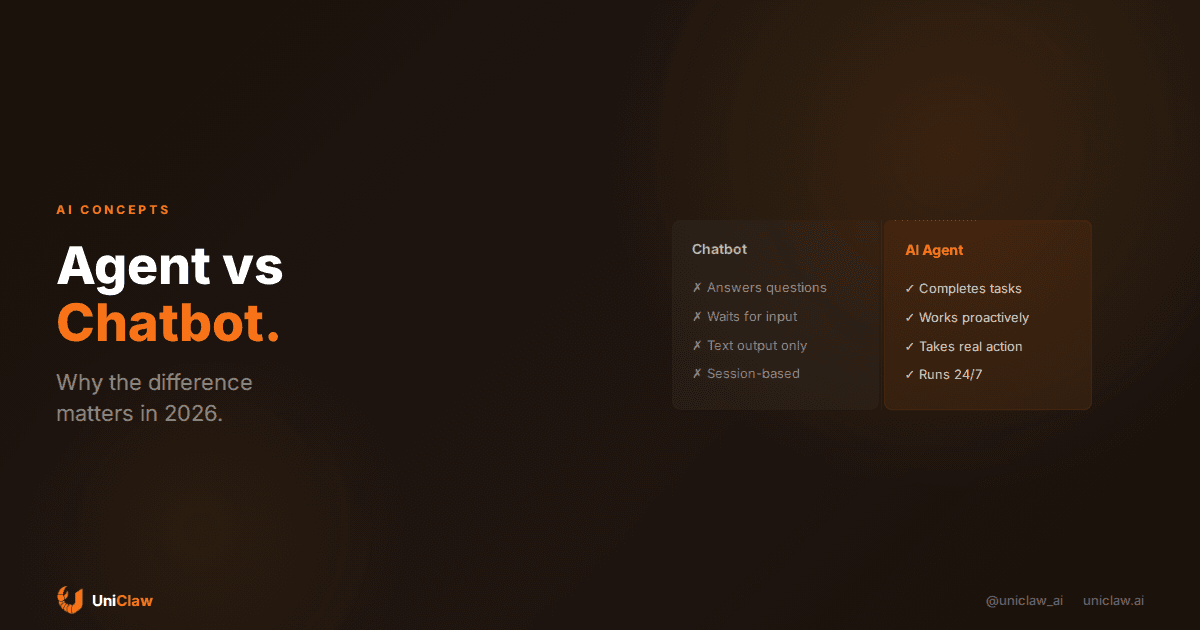
Every few months, the AI industry redefines its terminology. First it was "AI assistants." Then "copilots." Now everyone's talking about "AI agents."
But this isn't just marketing. The shift from chatbot to agent represents a fundamental change in what AI can do — and more importantly, what it can do without you watching.
The Chatbot Model: Ask → Answer
Chatbots — including ChatGPT, Claude, Gemini in their standard modes — follow a simple loop:
- You type a question
- The AI generates a response
- You read it
- You manually do whatever it suggested
The AI is reactive. It waits for you. And its output is always text — you're the one who has to turn that text into action.
Want to deploy a website? The chatbot tells you how. You do the deploying. Want to analyze data? The chatbot writes the script. You run it. Want to send an email? The chatbot drafts it. You copy-paste it into Gmail.
The bottleneck is always you.
The Agent Model: Goal → Action → Result
AI agents flip this entirely. Instead of answering questions, they accomplish goals.
An agent:
- Receives a task (or identifies one proactively)
- Plans the steps needed
- Executes those steps using tools (file system, browser, APIs, shell)
- Handles errors and adjusts its approach
- Delivers the result
The human provides the what. The agent handles the how.
Tell an agent "deploy a blog for our website" and it:
- Writes the code
- Sets up the server
- Publishes it to a live URL
- Tells you when it's done
No copy-pasting. No manual steps. No waiting.
Why This Matters Now
Three things converged in 2025-2026 to make agents viable:
1. Models Got Good Enough
The latest AI models (Claude Opus, GPT-4.5, Gemini Ultra) can reliably plan multi-step tasks, handle errors gracefully, and maintain context over long interactions. Two years ago, they couldn't.
2. Tool Use Became Reliable
Models can now consistently choose the right tool, format the right arguments, and interpret the results. Tool use went from "works sometimes" to "works reliably."
3. Open-Source Agents Arrived
Projects like OpenClaw made it possible for anyone to run an AI agent. Not a locked-down enterprise product — a real, open-source agent you control.
Comparing the Two
| Aspect | Chatbot | AI Agent |
|---|---|---|
| Output | Text responses | Completed tasks |
| Action | Suggests what to do | Does it |
| Persistence | Session-based | Runs continuously |
| Memory | Limited context window | Persistent files |
| Proactivity | Waits for input | Can initiate actions |
| Tools | Web search (maybe) | Shell, files, browser, APIs |
| Runs when you're away | No | Yes |
What Agents Can Do That Chatbots Can't
Work While You Sleep
A chatbot is useless when you're not typing. An agent running on a cloud server can monitor your email, check your deployments, and have a report ready when you wake up.
Chain Complex Actions
"Research competitor pricing, compare it to ours, create a spreadsheet, and email it to the team." A chatbot gives you steps. An agent does it end-to-end.
Maintain Long-Running Projects
Agents with persistent memory (like OpenClaw's MEMORY.md system) can work on projects over days and weeks, picking up where they left off each session.
Interact With the Real World
Agents can send messages, publish websites, call APIs, and run scripts. They operate in the same digital environment you do.
The Spectrum, Not the Binary
In practice, it's a spectrum. Many products are adding agentic features to chat interfaces:
- ChatGPT has code execution and file uploads
- Claude has artifacts and analysis tools
- Cursor/Windsurf are agentic coding assistants
But these are still fundamentally reactive — they need you in the loop for every step.
True agents like OpenClaw operate at the other end: fully autonomous, with their own computer, their own memory, and the ability to work independently.
Where Are Agents Headed?
The trajectory is clear:
2024: AI agents were experiments — impressive demos but unreliable in production.
2025: Agent frameworks matured. OpenClaw, CrewAI, and AutoGPT proved that autonomous AI could do real work.
2026 (now): Agents are becoming mainstream. People are deploying personal AI agents that run their email, manage their schedules, build their projects, and monitor their businesses.
2027 and beyond: Multi-agent systems. Your personal agent talking to your company's agents. Agent-to-agent commerce. The infrastructure is being built right now.
Getting Started With AI Agents
If you've been using chatbots and want to step into agents, here's the path of least resistance:
- Start with OpenClaw — it's open-source, well-documented, and the most popular agent framework in 2026
- Deploy it properly — either on a VPS or use UniClaw for one-click deployment
- Start small — have your agent do one thing well (e.g., daily briefings, code deployment)
- Expand gradually — add skills, connect more platforms, increase autonomy
The jump from chatbot to agent is the biggest upgrade in how you use AI. It's like going from reading a recipe to having a chef.
Why UniClaw Exists
We built UniClaw because the hardest part of AI agents isn't the AI — it's the infrastructure. Setting up a secure, persistent, well-connected environment for an agent to run is a weekend project for developers and impossible for everyone else.
UniClaw handles the infrastructure so you can focus on what your agent actually does. One click, dedicated machine, always on, starting at $12/month.
Your AI shouldn't be waiting for you to type. It should be working.
Follow us on X: @uniclaw_ai
Ready to deploy your own AI agent?
Get Started with UniClaw