
How to Orchestrate Multiple AI Agents (Without Losing Your Mind)
You've got one AI agent running. It handles your emails, maybe deploys some code, keeps an eye on your calendar. Life is good.
Then you get ambitious. You spin up a second agent for research. A third for customer support. A fourth for data analysis. Suddenly you're not managing agents — you're herding cats that hallucinate.
Multi-agent orchestration is the thing everyone in AI keeps talking about in 2026. Deloitte has a report on it. Microsoft published architecture patterns. Redis wants to sell you the infrastructure. But most of the conversation stays up in the clouds, literally. Enterprise diagrams. Buzzwords about "agentic workflows." Nobody wants to tell you what actually goes wrong when you run more than one agent.
So let me.
One agent is a tool. Two agents is a system. Three agents is politics.
The jump from one agent to two isn't just additive. It changes the category of the thing entirely. With one agent, you give it a task, it does the work, you check the output. Simple.
With two agents, new questions appear out of nowhere:
- Who decides what each agent works on?
- What happens when two agents try to modify the same file?
- How do agents share context without stepping on each other?
- When Agent A produces garbage, how does Agent B know to ignore it?
These aren't thought experiments. They're the stuff that breaks your setup at 2am on a Tuesday while you're asleep and your agents are very much awake.
The patterns that survive contact with reality
After seeing a bunch of multi-agent setups succeed and fail (mine included), a few patterns keep showing up. Microsoft's Azure team documented six of them, and they line up with what I've seen work in the real world.
Sequential handoff
Agent A finishes its job, passes the result to Agent B, who passes to Agent C. Assembly line.
This is the boring one, and boring is underrated. It works when your workflow has obvious stages — research, then writing, then editing. Each agent owns one step and doesn't care about the others.
It falls apart when you need feedback loops. If Agent C discovers Agent A missed something, you need Agent A to redo its work, and suddenly you're not running a line anymore, you're building a cycle. Cycles get complicated.
The orchestrator
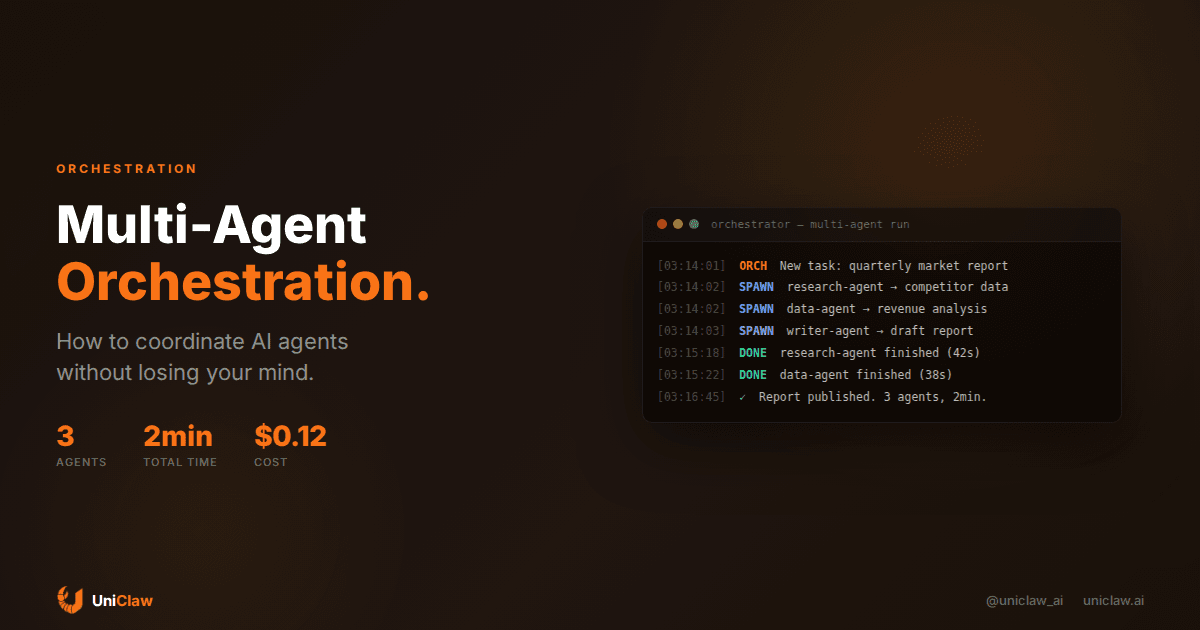
One boss agent coordinates everybody else. It takes the incoming task, breaks it into pieces, assigns each piece to a specialist, collects the results, and assembles the final output.
Popular for a reason. It mirrors how actual teams work. The orchestrator doesn't need to be brilliant at any specific domain. It needs to be good at delegation and at recognizing when a sub-agent's output is off.
OpenClaw handles this natively. Your main agent can spawn sub-agents, each with their own context and tools, and coordinate the whole thing. No framework, no YAML config, no third-party SDK. Just your agent deciding it needs help and creating a helper.
Generator-critic
One agent creates. Another evaluates. The generator produces a draft, the critic picks it apart, the generator revises. Repeat.
I like this one for writing and code. One round of self-critique already makes a noticeable difference. Two rounds is usually the sweet spot. Beyond that, the agents start going in circles, disagreeing on style preferences that don't matter.
Parallel execution
Multiple agents tackle different parts simultaneously. A research agent, a data agent, and a competitive analysis agent all work at once, and their results get merged at the end.
Speed is the win here. Coordination is the cost. You need a strategy for merging the outputs, and the agents need to produce work in compatible formats. Three agents producing three incompatible analyses just means three things you have to reconcile by hand.
What actually breaks
Theory is always clean. Here's what goes wrong in practice.
Context overflow. Agents sharing everything with each other fill up context windows fast. Your orchestrator burns half its tokens reading status updates instead of thinking about the actual problem. The fix: minimal context. Each agent gets what it needs for its task. Nothing extra.
Infinite loops. Agent A asks Agent B for clarification. Agent B asks Agent A. Neither can move. I put hard caps on back-and-forth now: three exchanges, then you make a decision with whatever you have. Imperfect decisions beat deadlocked agents.
The telephone problem. Information degrades as it passes between agents. Agent A's nuanced observation becomes Agent B's simplified summary becomes Agent C's wrong conclusion. Keep chains short. Let agents access source material directly when you can, instead of getting it filtered through another agent.
Cost surprise. Every agent call hits the API. An orchestrator running four sub-agents, each making tool calls, can chew through credits faster than you'd expect. I started tracking cost per workflow instead of per agent, and that shifted how I designed things. OpenClaw surfaces this pretty clearly, which helps — you can see exactly what a multi-agent run cost you after the fact.
How to start without overengineering it
If you're running one agent today and thinking about orchestration, here's my honest advice: don't build a system. Build a handoff.
Find the workflow where your agent does Step 1 and then you manually do Step 2. Automate that bridge. Two agents, sequential, one clear handoff. Live with it for a week.
Then try letting your main agent spawn a sub-agent for something specific. Research for a blog post. Reviewing a pull request. Drafting a reply to a long email thread. Watch how the delegation works. Tune the instructions until you're happy with the output.
Add more agents only when you're solving a specific problem. "This would be cool to try" is valid for a weekend experiment, not for a workflow you depend on.
You probably don't need a framework
Controversial take for 2026, when a new multi-agent framework launches every other week. CrewAI, LangGraph, AutoGen, Google ADK — they're fine tools, especially if you're building a product for other people to use.
For running your own agents? You need three things:
An agent that can delegate. OpenClaw does this out of the box. Your agent spawns sub-agents with specific instructions, tools, and constraints. Done.
Simple shared state. Files. I'm serious. A shared workspace where agents read and write files beats a message bus most of the time. Files are inspectable. You can open them and see what happened. They don't vanish when a process crashes.
Spending limits. The real risk with multi-agent orchestration isn't failure. It's expensive success. Set token budgets and time limits before you need them, not after your first $40 surprise run.
Where this goes
Gartner's prediction is that 15% of daily work decisions will be made autonomously by agents by 2028. That number seems low to me, but predictions are cheap and I've been wrong before.
The shift I find more interesting: agents coordinating across organizations. Your personal agent talks to your company's internal agent, which negotiates with a vendor's agent. The protocol infrastructure for this, things like MCP, is still early. But the building blocks exist, and they're getting assembled faster than most people realize.
We're also going to see a split between people who use one great general-purpose agent and people who run a small team of specialists. Both approaches work. The "team of specialists" approach gives you better results on complex tasks but requires more setup. The "one agent" approach is simpler and good enough for 80% of what most people need.
Try it
If you've got OpenClaw running, you can test multi-agent orchestration right now. Ask your agent to spawn a sub-agent for a task. It handles the context isolation, collects the results, and cleans up automatically. No configuration required.
If you don't have an agent yet, uniclaw.ai gets you deployed in a few minutes. Start with one agent. You'll know when you need two.
Ready to deploy your own AI agent?
Get Started with UniClaw