
AI Agent Memory: How Agents Actually Learn and Remember
Every AI agent has the same dirty secret: it wakes up with amnesia.
You spend an hour configuring your agent, teaching it your preferences, walking it through your project structure, explaining that no, you don't use tabs, you use spaces, and two of them. Next session? Gone. Clean slate. You're explaining the tabs thing again.
This is the memory problem, and it's the single biggest gap between "impressive demo" and "actually useful tool." In 2026, we're finally seeing real solutions. But most people are confused about what agent memory actually means, so let's fix that.
Context windows are not memory
I need to say this clearly because the marketing has gotten out of hand: a bigger context window is not memory. It's a bigger short-term buffer.
When Gemini announced a million-token context window, the headlines said "AI can finally remember everything." No. It can hold more text in its working memory for a single conversation. That's like saying someone has a great memory because they can keep a lot of papers on their desk. The moment they leave the room, the desk gets cleared.
Real memory means information persists across sessions. You tell your agent something on Monday, and it still knows it on Thursday. You don't have to re-explain your codebase, your preferences, or your project conventions every time you start a new chat.
The distinction matters because context windows have hard limits and they cost money. Stuffing your entire conversation history into the context window every time gets expensive fast and degrades performance. After a certain point, models start losing track of information buried in the middle of long contexts. Researchers call this "lost in the middle," and it's a real, measured phenomenon.
The three kinds of memory that matter
Borrowing from cognitive science (because the parallels are genuinely useful here), there are three types of memory that agents need:
Semantic memory is facts and knowledge. "The user prefers Python over JavaScript." "The production database is on port 5432." "The team does standups at 9am Pacific." This is the stuff you'd put in a reference document.
Episodic memory is what happened. "Last Tuesday, the deploy failed because of a missing env variable." "The user asked me to never send emails without confirmation." This is your timeline of events and interactions.
Procedural memory is how to do things. "When the user says 'deploy,' run the test suite first, then push to staging, then notify the team channel." This is learned workflows and patterns.
Most agents in 2026 have some version of semantic memory, usually a file or database where they store facts. Fewer have episodic memory, the ability to recall what happened in past interactions. Almost none have real procedural memory, where the agent gets better at tasks over time by learning from its own experience.
How memory actually works under the hood
There's no magic. Agent memory systems generally work in one of a few ways.
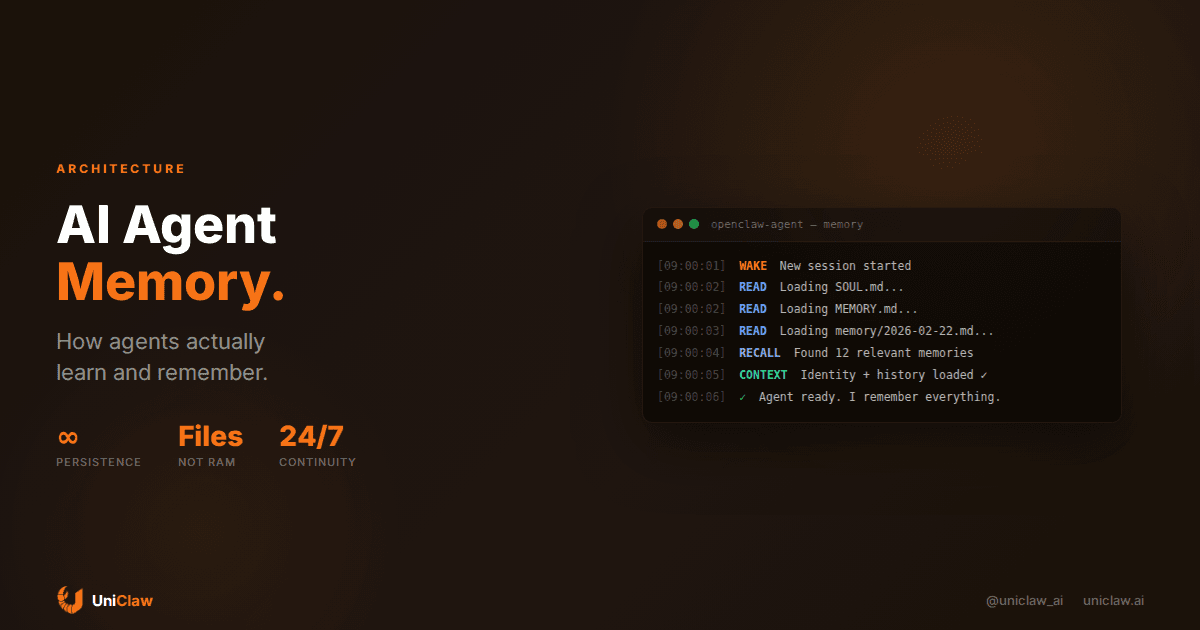
The simplest approach: write things to files. OpenClaw does this. Your agent has a workspace with markdown files. It writes daily notes, keeps a long-term memory document, and reads them back when it wakes up. It's crude. It also works surprisingly well. The agent decides what's worth remembering and what to forget, which is closer to how human memory works than you might expect.
A step up: vector databases. The agent stores memories as embeddings (numerical representations of text) in something like Redis or Pinecone. When it needs to recall something, it does a semantic search: "what do I know about the user's deployment process?" and gets back the most relevant memories. This scales better than flat files but adds complexity.
Then there's the structured approach, used by tools like Mem0 and Letta. These maintain explicit memory objects with metadata: when the memory was created, how often it's been accessed, what category it belongs to. The agent can update, merge, or deprecate memories over time. A memory from six months ago that hasn't been accessed gets ranked lower than one from last week that keeps coming up.
The interesting research right now is in "sleep-time compute," where agents process and consolidate their memories when they're not actively being used. Like how human memory consolidation happens during sleep. Your agent reviews its recent interactions overnight, extracts patterns, updates its long-term memory, and throws away the noise. Letta published work on this approach and the results are promising: agents with sleep-time memory processing outperformed those with full-context access on several benchmarks.
Why most implementations get this wrong
Here's the part where I have opinions.
Most agent memory implementations treat every piece of information as equally worth remembering. That's wrong. Human memory is selective for good reasons. If you remembered every single thing that happened to you with perfect fidelity, you'd be overwhelmed and unable to function. (There's actually a documented condition for this, hyperthymesia, and people who have it often find it debilitating.)
Good agent memory needs forgetting. Or at least, it needs prioritization. The fact that the user prefers dark mode is worth storing permanently. The fact that they asked about the weather last Tuesday probably isn't. A smart memory system treats these differently.
Another common mistake: storing raw conversation transcripts as memory. This is the vector database equivalent of hoarding. Yes, you can embed every message and retrieve semantically similar ones later. But the signal-to-noise ratio is terrible. Most conversation turns are procedural ("yes," "do that," "looks good") and don't contain information worth persisting.
The better approach is extraction and consolidation. After a conversation, the agent reviews what happened and pulls out the things worth keeping: decisions made, preferences expressed, facts learned, mistakes to avoid. It stores those distilled insights, not the raw transcript. This mirrors what the cognitive science literature calls "consolidation," the process of turning short-term memories into long-term ones.
What to look for in an agent with memory
If you're picking an agent platform and memory matters to you (it should), here's what I'd check:
Does the agent persist information across sessions without you manually copying context? This is the bare minimum. If you have to re-explain things every time, the agent doesn't really have memory, it has a notepad you're managing.
Can the agent decide what to remember on its own? An agent that only stores what you explicitly tell it to store is a database with a chat interface. You want one that notices patterns, extracts preferences, and builds knowledge over time.
Does the agent handle memory conflicts? If you told it you prefer Python in January but you've been writing TypeScript for three months, does it update its model of you? Or does it still suggest Python?
Is memory scoped and private? Your agent's memory of your preferences, your projects, your API keys, this stuff shouldn't leak into other people's sessions. This seems obvious but is worth checking. The Moltbook API key incident showed what happens when agent-stored credentials aren't properly isolated.
Where OpenClaw fits in
I'll be direct about this since it's our blog. OpenClaw's approach to memory is file-based and transparent. Your agent has a workspace. It writes things down in markdown files: daily notes in memory/YYYY-MM-DD.md, long-term knowledge in MEMORY.md. You can read these files yourself. You can edit them. If the agent remembered something wrong, you fix the file.
This won't win any awards for technical sophistication. But it has real advantages. You can see exactly what your agent remembers. There's no opaque vector database where memories disappear into embeddings you can't read. The agent's memory is human-readable, auditable, and version-controllable. You can put it in git if you want.
The trade-off is scalability. If your agent needs to recall from thousands of past interactions, file-based memory gets slow. For most personal and small-team use cases, though, it holds up fine. And the transparency is worth a lot when you're trying to trust an autonomous system with access to your tools and data.
The real question
Agent memory is getting better fast. The gap between "goldfish that forgets everything" and "assistant that actually knows you" is closing. Within a year, I'd expect most serious agent platforms to have some form of persistent, consolidated memory that works across sessions without manual intervention.
The harder question isn't technical. It's about trust. How much do you want an AI system to remember about you? Where's the line between "helpful persistence" and "uncomfortable surveillance"? We haven't figured this out for regular apps and we're definitely not going to figure it out for agents overnight.
For now, my advice: pick an agent that remembers things, and pick one where you can see and control what it remembers. Opacity in memory is a deal-breaker. If you can't audit it, you can't trust it.
Want an AI agent that remembers your preferences, learns your workflows, and lets you see exactly what it knows? Try OpenClaw. Your agent, your memory, your data. Get started at uniclaw.ai.
Follow us on X: @uniclaw_ai
Ready to deploy your own AI agent?
Get Started with UniClaw